This is the third of three articles posted on the above subject.
1. Evaporation of water posted 6/15/10
2. The emission of smoke. Posted 6/22/10
3. The charcoal phase.
The charcoal phase:
As the fire progresses and most of the gases and tars have vaporized out of the wood, charcoal
remains.
Charcoal is almost 100% carbon and burns with a red glow and very little flame or smoke.
Charcoal is a good fuel that burns easily and cleanly when enough oxygen is present.

Tuesday, June 29, 2010

Tuesday, June 22, 2010
What happens when wood burns - Part 2 of 3 postings
This is the second of three articles on the above subject.
1. Evaporation of water posted 6/15/10.
2. The emission of smoke.
3. The charcoal phase to be posted 6/29/10.
The emission of smoke:
As the wood heats up above the boiling point of water, it starts to smoke. The smoke is visible result of the decomposition of the solid wood as it vaporizes into a cloud of combustible gases and tar droplets.
The smoke will burn if the temperature is high enough and oxygen is present. When the smoke burns, it produces the bright red flames that are characteristic of wood combustion.
If smoke does not burn in the firebox, it will exit the appliance and into the chimney where it will either condense forming creosote deposits or be expelled as air pollution.
Unburned smoke represents an efficiency loss because it contains a large part of the total energy in the wood.
However, catalytic stoves with the use of a catalytic combustor, burns this smoke before it is expelled as air pollution and burns it as a fuel to produce heat that can be 2-3 times hotter than the firebox temperature.
This also gives a higher efficiency out of the stove. At the same time, the catalytic combustor will burn up to 90% of the creosote contained in the smoke.
1. Evaporation of water posted 6/15/10.
2. The emission of smoke.
3. The charcoal phase to be posted 6/29/10.
The emission of smoke:
As the wood heats up above the boiling point of water, it starts to smoke. The smoke is visible result of the decomposition of the solid wood as it vaporizes into a cloud of combustible gases and tar droplets.
The smoke will burn if the temperature is high enough and oxygen is present. When the smoke burns, it produces the bright red flames that are characteristic of wood combustion.
If smoke does not burn in the firebox, it will exit the appliance and into the chimney where it will either condense forming creosote deposits or be expelled as air pollution.
Unburned smoke represents an efficiency loss because it contains a large part of the total energy in the wood.
However, catalytic stoves with the use of a catalytic combustor, burns this smoke before it is expelled as air pollution and burns it as a fuel to produce heat that can be 2-3 times hotter than the firebox temperature.
This also gives a higher efficiency out of the stove. At the same time, the catalytic combustor will burn up to 90% of the creosote contained in the smoke.
Tuesday, June 15, 2010
What happens when wood burns - Part 1 of 3 postings
This is the first of three articles that I will be posting on the above subject.
1. Evaporation of water
2. The emission of smoke to be posted 6/22/10.
3. The charcoal phase to be posted 6/29/10.
Evaporation of water:
Up to half the weight of a freshly cut log is water. After proper seasoning the water content is reduced to about 20 percent. As the wood is heated in the firebox, this water boils off, consuming heat energy in the process. The wetter the wood, the more heat energy is consumed. That is why wet firewood hisses and sizzles and is hard to burn, while properly seasoned wood innites and burns easily.
Re-fueling with wet or unseasoned wood in a catalytic stove will send moist smoke to the catalytic combustor and cause the combustor to stop working.
It will cause the stove to struggle and not operate properly.
In addition re-fueling with wet or unseasoned wood and operating the stove with the by-pass closed, can cause damage to the catalytic combustor.
1. Evaporation of water
2. The emission of smoke to be posted 6/22/10.
3. The charcoal phase to be posted 6/29/10.
Evaporation of water:
Up to half the weight of a freshly cut log is water. After proper seasoning the water content is reduced to about 20 percent. As the wood is heated in the firebox, this water boils off, consuming heat energy in the process. The wetter the wood, the more heat energy is consumed. That is why wet firewood hisses and sizzles and is hard to burn, while properly seasoned wood innites and burns easily.
Re-fueling with wet or unseasoned wood in a catalytic stove will send moist smoke to the catalytic combustor and cause the combustor to stop working.
It will cause the stove to struggle and not operate properly.
In addition re-fueling with wet or unseasoned wood and operating the stove with the by-pass closed, can cause damage to the catalytic combustor.
Tuesday, June 8, 2010
Tips on Fueling Techniques


Small pieces of wood arranged loosely in a crisscross pattern burn quickly because the combustion air can reach all the pieces at once.


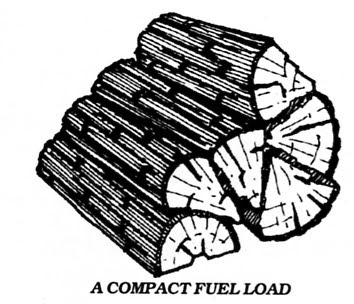
Larger pieces placed compactly burn more slowly because there are fewer spaces where the air can penetrate the load.

Never add just one or two pieces of wood to a fire. Three or more pieces are needed to form a sheltered pocket of glowing coals that reflect heat toward each other and sustain the fire.
Tuesday, June 1, 2010
Firewood vs Heating oil prices
According to an article I read awhile back, heating oil averaged $3.527 a gallon in 2008.


How does this compare to burning wood in a catalytic stove?
According to the experts, 166 gallons of oil equals one cord of wood.
This is $585.48 compared to the price of one cord of wood.
Do the math and compare your cost savings.
Wood heat in a catalytic stove is the least expensive heat available.
Further, wood is an entirely domestic resource.
Subscribe to:
Posts (Atom)